The Importance of Artificial Intelligence Tools in Combating Illegal and Harmful Content
DOI:
https://doi.org/10.61823/dpia.2026.2.569Keywords:
cybersecurity, illegal content, artificial intelligence, cyber threats, digital servicesAbstract
The convergence of various areas of our lives has led to a particular type of conflict regarding the scope and level of new regulations, especially in relation to digital content, where most issues concern new media and new technologies, including the liability of digital service providers. New models of content management (including online) are emerging, supported by new principles of the virtual organisation of the digital market. Changes in communication technology have fundamentally altered the way individuals and entire communities function. Online multimedia platforms providing electronic services are emerging, which require the use of modern technological solutions and in which the private sector most often invests. On the one hand, an open and free cyberspace allows for the exchange of cultures and experiences between nations, communities and citizens, facilitating interaction and the exchange of content, and consequently of knowledge, experiences and technology. On the other hand, this openness triggers activities that encroach upon the realm of rights and freedoms. This article addresses these elements of a new phase in the development of breakthrough technologies such as artificial intelligence, which require an analysis of the impact of new technological tools on the digital environment and the legal situation of the individual. This is particularly evident in procedures related to combating illegal and harmful content.
References
Bergamini D., Need for democratic governance of artificial intelligence. Report for the Parliamentary Assembly of the Council of Europe, doc. 15150, 24 September 2020.
Berle I., Face Recognition Technology: Compulsory Visibility and its Impact on Privacy and the Confidentiality of Personal Identifiable Images, Springer, 2020.
Buolamwini J., Gebru T., Gender Shades: Intersectional Accuracy Disparities in Commercial Gender Classification, “Proceedings of Machine Learning Research” 2018, 81, pp. 1-15.
Burt C., Concerns about biometric online proctoring expressed by students in Australia, the US and Canada, Biometric Update. 3 July 2020, https://www.biometricupdate.com/202007/concerns-about-biometric-online-proctoring-expressed-by-students-in-australia-u-s-and-canada.
Bygrave L.A., Tosoni L., Article 4(14). Biometric Data, [in:] The EU General Data Protection Regulation (GDPR): A Commentary, eds. C. Kuner, L.A. Bygrave, C. Docksey, Oxford University Press, Oxford 2020, pp. 207-216.
CAHAI. Feasibility study. CAHAI(2020)23. Council of Europe, Strasbourg. 17 December 2020.
Clifford D., Richardson M., Witzleb N., Artificial Intelligence and Sensitive Inferences: New Challenges for Data Protection Laws, [in:] Regulatory Insights on Artificial Intelligence: Research for Policy, eds. M Findlay et al., Edward Elgar, Cheltenham, UK, 2021, pp. 19-45.
Cobbe J., Ah Lee M.S., Singh J., Reviewable Automated Decision-Making: A Framework for Accountable Algorithmic Systems. ACM Conference on Fairness, Accountability, and Transparency (FAccT’ 21), 1-10 March 2021, Virtual Event, Canada, ACM, New York, NY, USA.
Garton Ash T., Free Speech: Ten Principles for a Connected World, Kraków 2018.
Kind C., Containing the canary in the AI coalmine – the EU’s efforts to regulate biometrics Ada Lovelace Institute Blog. 30 April 2021, https://www.adalovelaceinstitute.org/blog/canary-ai-coalmine-eu-regulate-biometrics/.
Kindt E., A First Attempt at Regulating Biometric Data in the European Union [in:] Regulatory Insights on Artificial Intelligence: Research for Policy, eds. M Findlay et al., Edward Elgar, Cheltenham, UK, 2021, pp. 62-69.
Spivak C., Garvie A., Taxonomy of Legislative Approaches to Face Recognition in the United States, [in:] Regulating Biometrics: Global Approaches and Urgent Questions, ed. A. Kak, AI Now Institute, 1 September 2020, pp. 86-95, https://ainowinstitute.org/regulatingbiometrics.html.
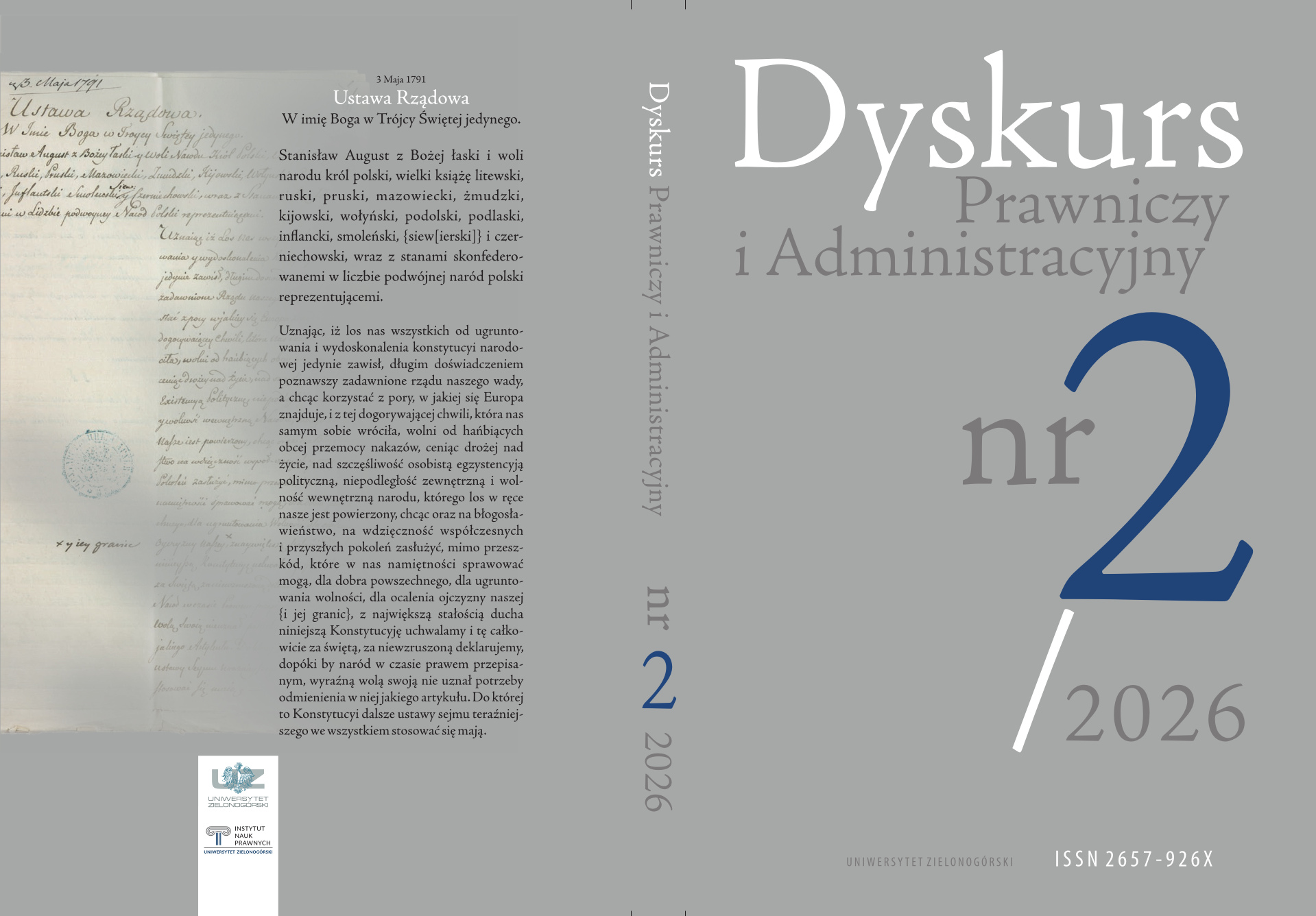
Downloads
Published
Issue
Section
License
Copyright (c) 2026 Katarzyna Chałubińska-Jentkiewicz

This work is licensed under a Creative Commons Attribution-NonCommercial-NoDerivatives 4.0 International License.